Inflation is one of the most important concepts in economics and finance because it affects the prices people pay, the value of money, the cost of borrowing, business decisions, wages, savings and the wider economy.
But understanding what inflation is only tells part of the story.
The next important question is: what actually causes inflation?
Why do prices rise across an economy? Why can the cost of food, housing, energy, transportation and services increase at the same time? Why can inflation sometimes remain low and stable, while at other times prices rise much more rapidly?
There is no single answer.
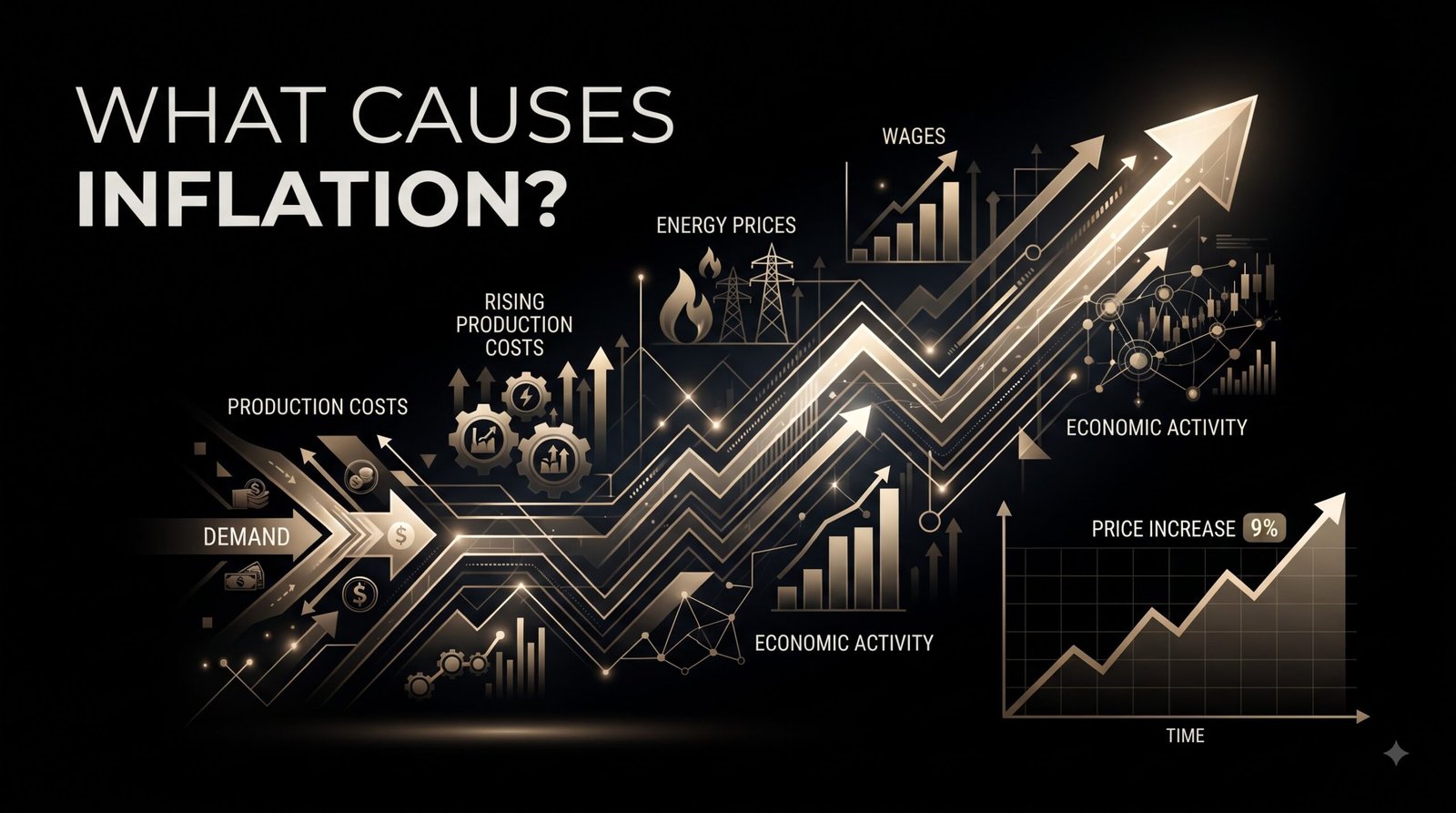
Inflation can be caused by a combination of economic forces. Demand can become stronger than the available supply of goods and services. Businesses can face higher production costs. Supply chains can be disrupted. Wages can increase. Energy and commodity prices can rise. Monetary and financial conditions can influence spending and borrowing. Expectations about future prices can also affect current economic behaviour.
Understanding these different forces provides an important foundation for understanding economics, personal finance and investing.
This guide explains the major causes of inflation, how they interact with one another and why identifying the underlying cause of inflation matters.
What Causes Inflation?
Inflation occurs when the general level of prices for goods and services increases over time.
The causes of inflation can vary considerably from one period to another.
Sometimes inflation is primarily driven by strong demand. Sometimes businesses face rapidly increasing costs. Sometimes a major supply disruption reduces the availability of important goods. In other situations, several of these factors occur simultaneously.
Inflation can therefore be thought of as the result of different pressures affecting the balance between demand, supply, production costs, money, credit and expectations throughout an economy.
This is why economists generally look beyond the headline inflation rate and examine what is driving price increases underneath it.
Demand-Pull Inflation
One of the most widely discussed causes of inflation is known as demand-pull inflation.
Demand-pull inflation can occur when demand for goods and services grows faster than an economy’s ability to produce and supply them.
Imagine an economy where households suddenly have significantly more money available to spend. Consumers may increase their purchases of cars, restaurants, travel, electronics, housing and other goods and services.
If businesses have enough spare capacity to meet this additional demand, production can increase without causing substantial price pressure.
However, if the economy is already operating close to its productive capacity, businesses may struggle to increase supply quickly enough.
When too many buyers are competing for a limited amount of goods and services, businesses may have greater ability to increase prices.This is the basic idea behind demand-pull inflation.
How Strong Demand Can Push Prices Higher
Strong demand can affect prices through several channels.
Businesses may receive more orders than they can immediately fulfil. They may experience shortages of workers, materials, equipment or production capacity.
As businesses compete for scarce resources, their costs can increase.
At the same time, strong consumer demand can give businesses greater pricing power because customers may remain willing to purchase products even when prices rise.This means demand can contribute to inflation both directly and indirectly.
Demand-pull inflation can be particularly noticeable during periods of strong economic growth when consumer spending, business investment and employment are all increasing.
Cost-Push Inflation
Another major cause of inflation is cost-push inflation.
Cost-push inflation occurs when the costs of producing goods and services increase and businesses respond by raising prices.
Businesses use many different inputs to produce what they sell.
These can include labour, energy, raw materials, transportation, machinery, rent, technology and other services.
If the cost of important inputs increases significantly, businesses may attempt to protect their profit margins by passing some of those higher costs on to customers.
For example, if the cost of energy rises substantially, companies that depend heavily on energy may face higher operating costs.
Those increased costs can eventually appear in the prices charged for their products and services.
Supply Shocks and Inflation
Supply shocks can be another important source of inflation.
A supply shock occurs when an unexpected event significantly affects the availability or cost of goods, services or productive inputs.
Supply shocks can result from natural disasters, geopolitical events, wars, extreme weather, major transportation disruptions, shortages, production failures or interruptions to international supply chains.
If the supply of an important product suddenly falls while demand remains relatively strong, its price can increase.The effects can then spread through the wider economy.
For example, if an important raw material becomes significantly more expensive, businesses that use that material may face higher production costs. Those businesses may increase their prices, affecting other companies and consumers further down the supply chain.
This is one reason a disruption in one part of the economy can sometimes contribute to broader inflation.
Energy and Commodity Prices
Energy and commodity prices can have a particularly wide influence on inflation.Oil, natural gas, electricity and other forms of energy are used throughout the economy.
Energy is required to transport goods, operate factories, heat and cool buildings and provide many different services.
When energy prices rise significantly, businesses may face higher operating and transportation costs.Commodity prices can have similar effects.
Agricultural products, metals, energy resources and other raw materials are inputs into countless products and services.
A major increase in the price of an important commodity can therefore affect businesses and consumers far beyond the original commodity market.
However, a temporary increase in the price of one commodity does not automatically mean an economy has entered a period of broad inflation.
The wider effects depend on how large the price change is, how long it lasts and how strongly it spreads through other prices.
Wages and Labour Costs
Wages can also play an important role in inflation.
Workers provide the labour businesses need to produce goods and services.If wages increase significantly, businesses may face higher labour costs.
Businesses may respond by accepting lower profit margins, improving productivity, reducing other costs or increasing the prices they charge.
Higher wages can also increase household purchasing power.
When people have more income available to spend, demand for goods and services can increase.
This means wage growth can influence inflation through both the cost side and the demand side of the economy.
However, higher wages do not automatically cause inflation.
Wages can increase because workers become more productive, labour markets become stronger or living standards improve.
If productivity increases alongside wages, businesses may be able to absorb higher wages without substantially increasing prices.
The relationship between wages and inflation is therefore complex.
The Wage-Price Relationship
A particularly important concept is the possibility of a wage-price spiral.This can occur when rising prices lead workers to demand higher wages, while higher wages contribute to businesses increasing prices further.
Higher prices then create additional pressure for workers to seek further wage increases.If this process becomes widespread and persistent, it can contribute to continuing inflation.
However, the existence of wage increases does not automatically mean a wage-price spiral is occurring.
Economists consider factors such as productivity, labour-market conditions, profit margins, inflation expectations and overall demand when assessing these relationships.
Money, Credit and Inflation
Money and credit can also influence inflation.
When financial conditions encourage households and businesses to borrow and spend, overall demand throughout the economy can increase.
Banks and other financial institutions play an important role in the availability of credit.
When borrowing is relatively inexpensive and credit is readily available, households may be more willing to purchase homes, vehicles and other goods, while businesses may be more willing to invest and expand.
If spending grows significantly faster than the economy’s ability to produce goods and services, inflationary pressure can develop.
However, the relationship between money, credit and inflation is not as simple as saying that creating more money automatically causes prices to rise by a specific amount.
The effects depend on how money and credit move through the economy, how much people spend, how much businesses produce and what is happening to productivity, demand and supply.
Interest Rates and Inflation
Interest rates can influence inflation by affecting borrowing, saving, spending and investment.
When interest rates are lower, borrowing can become less expensive.
Households may be more willing to borrow and spend, while businesses may find it more attractive to finance investment and expansion.
This can increase economic activity and, under certain conditions, add to demand.When inflationary pressures become too strong, central banks may increase interest rates in an attempt to slow demand and reduce inflationary pressure.
Higher interest rates can make mortgages, loans and other forms of borrowing more expensive.
They can also encourage saving and reduce the attractiveness of certain forms of spending and investment.The effects of interest-rate changes are not immediate, however.
Monetary policy typically affects the economy with a time lag, meaning that changes in interest rates today can influence economic activity and inflation over the months and years that follow.
Inflation Expectations
Expectations about future inflation can themselves influence inflation.If households and businesses believe prices will rise significantly in the future, they may change their behaviour today.
Workers may seek higher wages in anticipation of rising living costs.Businesses may increase prices in anticipation of higher future costs.
Consumers may bring purchases forward because they expect products to become more expensive.These behaviours can contribute to additional demand and price increases.This is why inflation expectations are closely monitored by economists and central banks.
If people and businesses generally believe that inflation will remain stable, inflation can be easier to control.
If expectations become firmly established that prices will continue rising rapidly, bringing inflation back down can become more difficult.
Government Spending and Fiscal Policy
Government spending can also influence inflation under certain economic conditions.
When governments increase spending, they can add to overall demand in the economy.
If there is sufficient unused productive capacity, businesses may be able to increase production to meet that additional demand.
However, if an economy is already operating near capacity, additional demand can place greater pressure on available goods, services, workers and resources.This can contribute to inflation.
Government taxation and other fiscal policies can also influence household disposable income, business activity and overall demand.The relationship between government policy and inflation is therefore dependent on the broader economic environment.
Global Events and International Inflation
Modern economies are highly interconnected.
Countries import and export enormous quantities of goods, services, energy, raw materials and components.
As a result, inflation can sometimes be influenced by events occurring outside a country’s borders.International conflicts, supply-chain disruptions, changes in commodity prices, shipping costs, natural disasters and changes in global demand can all affect domestic prices.
A country does not necessarily need to experience a major domestic economic boom for inflationary pressure to increase.
Global developments can transmit price pressures from one economy to another through international trade.
Exchange Rates and Inflation
Exchange rates can also influence inflation.
An exchange rate determines how much one currency is worth relative to another currency.
When a country’s currency loses value relative to other currencies, imported goods can become more expensive when measured in the domestic currency.This can affect products such as imported energy, food, machinery, technology and raw materials.
Businesses that rely heavily on imported inputs may face higher costs and may pass some of those costs on to customers.
A weaker currency can therefore contribute to inflation through higher import prices.The strength of this effect depends on how dependent an economy is on imports and how businesses and consumers respond to changing prices.
Productivity and Inflation
Productivity is another important part of the inflation story.
Productivity refers broadly to how efficiently an economy produces goods and services using its available resources.
When productivity increases, businesses may be able to produce more output without increasing their costs proportionally.
This can help reduce upward pressure on prices.
For example, technological improvements can allow a company to produce more goods with the same amount of labour and equipment.
Higher productivity can therefore help an economy accommodate stronger demand without generating as much inflationary pressure.
Low productivity growth, on the other hand, can make it more difficult for businesses to increase output while keeping costs under control.
Housing Costs and Inflation
Housing can have a significant influence on the inflation experience of households.
Housing-related expenses can include rent, utilities, maintenance, insurance and other associated costs.
When housing demand is strong and available supply is limited, rents and property-related costs can increase.Construction costs can also affect the supply of new housing.
Higher prices for land, labour, materials, financing and energy can make new construction more expensive.
The way housing costs are measured within official inflation statistics varies between countries, so the relationship between property markets, rents and headline inflation can differ across economies.
Food Prices and Inflation
Food prices can be particularly noticeable to consumers because food is an essential part of everyday spending.
Food prices can be affected by weather conditions, agricultural production, energy costs, transportation, labour costs, fertiliser prices, supply-chain disruptions and global commodity markets.
A poor harvest, for example, can reduce the supply of a particular agricultural product.If demand remains strong while supply falls, prices may increase.
Food-price increases can therefore contribute to headline inflation, although temporary changes in food prices do not necessarily indicate that broader inflationary pressures are becoming persistent.
Why Inflation Can Have Multiple Causes
One of the most important things to understand about inflation is that different causes can occur at the same time.
An economy might experience strong consumer demand while businesses are simultaneously dealing with higher energy costs and supply shortages.
At the same time, wages may be increasing and households may have strong expectations that prices will continue rising.These forces can reinforce one another.This makes it difficult to identify a single cause of inflation in many real-world situations.
Economists therefore examine a broad range of indicators when trying to understand why prices are rising.
Can Inflation Become Self-Reinforcing?
Inflation can sometimes become self-reinforcing when different economic forces begin feeding into one another.
For example, higher energy prices can increase business costs.Businesses may then increase their prices.
Workers may respond by seeking higher wages to compensate for the increased cost of living.
Higher wages can increase household spending power and business labour costs.
Businesses may then increase prices again.If consumers and businesses begin expecting continued inflation, they may adjust their behaviour in ways that create additional price pressure.
This does not mean that inflation will inevitably continue once it begins.
Economic conditions can change, supply can recover, demand can weaken and monetary policy can influence spending and borrowing.The important point is that inflation can involve feedback between different parts of the economy.
Why Central Banks Care About the Causes of Inflation
Central banks closely monitor inflation because the appropriate response can depend on what is causing it.
If inflation is being driven primarily by excessive demand, tighter monetary policy may help reduce spending and economic pressure.
If inflation is being driven by a temporary supply shock, raising interest rates may have a different effect because monetary policy cannot directly create more oil, food, computer chips or other scarce goods.
Central banks therefore consider the persistence, breadth and underlying causes of inflation rather than looking only at the headline inflation rate.
Understanding the source of inflation helps policymakers determine how persistent the problem may be and what economic conditions could cause it to continue.
Why Understanding the Cause of Inflation Matters
Knowing that prices are rising is useful, but understanding why they are rising provides much more information.
If inflation is primarily driven by temporary supply disruptions, it may behave differently from inflation caused by persistent excess demand.
If inflation is being driven by higher energy prices, it may affect some industries and households differently from inflation caused by strong consumer demand.
If inflation expectations become deeply established, inflation may prove more persistent.The cause of inflation can therefore influence how households, businesses, governments and investors interpret the economic environment.
Understanding these differences is an important part of financial and economic literacy.
Is Inflation Caused by One Thing?
Usually not.Inflation is generally the result of several economic forces interacting with one another.
Demand, supply, production costs, wages, energy prices, money, credit, interest rates, expectations, government policy, exchange rates, productivity and global developments can all influence price levels.
The relative importance of each factor can change over time.This is why the causes of inflation must be considered in the context of the particular economy and period being studied.
Frequently Asked Questions About What Causes Inflation
What Is the Main Cause of Inflation?
There is no single main cause that explains every episode of inflation. Inflation can result from strong demand, higher production costs, supply disruptions, monetary and financial conditions, inflation expectations and other economic factors.
Does High Demand Cause Inflation?
High demand can contribute to inflation when demand for goods and services grows faster than businesses can increase supply. When available productive capacity becomes constrained, businesses may have greater ability to increase prices.
Does an Increase in Wages Cause Inflation?
Higher wages can contribute to inflation by increasing business labour costs and household purchasing power. However, wage increases do not automatically cause inflation because productivity, labour-market conditions and other economic factors also matter.
Do Higher Oil Prices Cause Inflation?
Higher oil and energy prices can contribute to inflation because energy is an important input into transportation, manufacturing and many other economic activities. The broader effect depends on how large and persistent the price increase is.
Does Printing Money Cause Inflation?
An increase in the money supply can contribute to inflation under certain economic conditions, particularly when monetary expansion contributes to demand growing faster than the economy’s ability to produce goods and services. However, the relationship is not mechanical, and inflation depends on many interacting economic factors.
Do Low Interest Rates Cause Inflation?
Low interest rates can contribute to inflationary pressure when they encourage borrowing, spending and investment strongly enough to increase demand beyond available supply. However, low interest rates do not automatically produce inflation.
Can Government Spending Cause Inflation?
Government spending can contribute to inflation when it significantly increases demand in an economy that is already operating near its productive capacity. The effect depends on the scale and type of spending and the wider economic environment.
Can Supply Shortages Cause Inflation?
Yes. If the supply of important goods or services falls while demand remains strong, prices can increase. Widespread supply disruptions can contribute to broader inflation.
Can Inflation Be Caused by Global Events?
Yes. Global commodity prices, wars, natural disasters, supply-chain disruptions, shipping costs and international demand can all influence domestic inflation through trade and financial connections between economies.
Can Inflation Have More Than One Cause?
Yes. Inflation frequently results from multiple factors occurring at the same time. Strong demand, higher production costs, supply shortages, wage pressures and changing expectations can interact and reinforce one another.
Why Does Inflation Sometimes Last for a Long Time?
Inflation can become persistent when the forces driving price increases remain in place or when different inflationary pressures begin reinforcing one another. Expectations, wages, demand, production costs and monetary conditions can all influence how long inflation lasts.
Can Inflation Fall Without Prices Falling?
Yes. If the inflation rate falls from 6% to 3%, prices are still rising, but they are rising more slowly. This situation is known as disinflation. Prices generally need to decline for the economy to experience deflation.
What Should I Learn About Inflation Next?
Understanding what causes inflation provides an important foundation for exploring the consequences of rising prices.The next step is to understand what inflation actually means for your money, savings and financial position.
Inflation can affect the real value of cash, savings, income and investment returns. It can also interact with interest rates, financial markets and different asset classes in important ways.
Understanding these relationships can help you develop a broader understanding of how inflation fits into the financial world.
Continue Learning About Inflation
Understanding why inflation occurs is an important step toward developing a deeper understanding of economics and finance.
Inflation is not caused by one simple factor. It can emerge from changing demand, limited supply, rising production costs, wage pressures, energy prices, monetary and financial conditions, government policy, global events and expectations about the future.
Once you understand these underlying forces, you can begin exploring the more advanced questions surrounding inflation and its effects on households, businesses, savings, investments and financial markets.
Our premium finance and investing resources build on these foundations with deeper educational content exploring inflation’s potential effects on money, savings, investments, asset classes, portfolios, interest rates, risk management and broader economic conditions.
Explore the free resources to continue building your financial knowledge, or explore the premium collection when you are ready to take your understanding further.
Leave a Reply