Inflation is one of the most important concepts in finance and economics because it affects almost every part of everyday financial life. It can influence the cost of food, housing, transportation, energy, services and other goods, while also affecting wages, savings, borrowing, interest rates, businesses, governments and financial markets.
But what exactly is inflation?
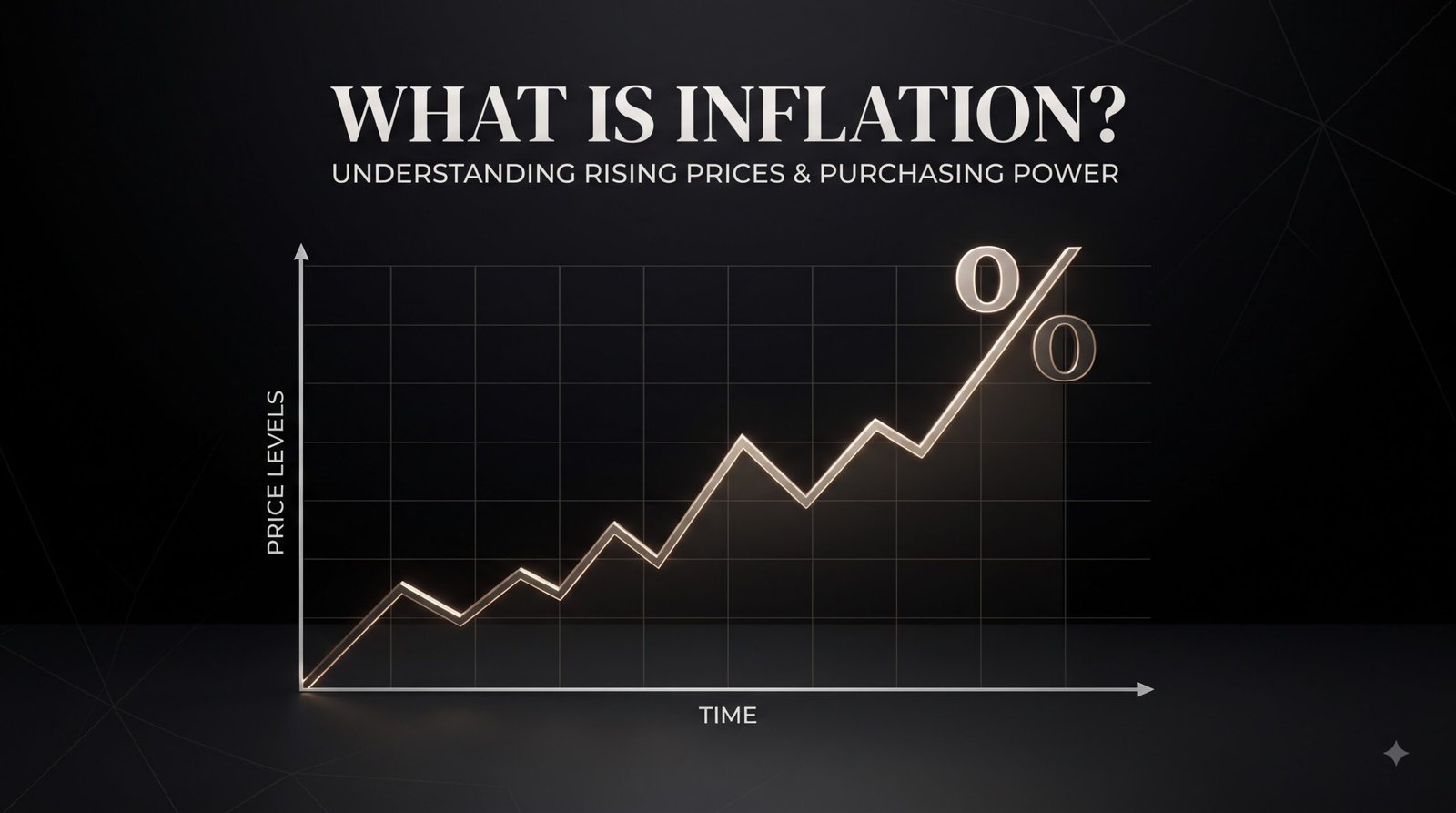
In simple terms, inflation is a sustained increase in the general level of prices for goods and services over time. When inflation occurs, the purchasing power of money generally falls, meaning that the same amount of money can buy fewer goods and services than it could previously.
Understanding inflation is essential for anyone who wants to develop a strong foundation in personal finance, economics or investing. It helps explain why the cost of living changes over time, why central banks pay close attention to price growth and why the value of money today cannot always be compared directly with its value many years ago.
This guide explains what inflation means, how it works, how it is measured, why it happens, the different forms inflation can take and why inflation matters to individuals and the wider economy.
Inflation Explained in Simple Terms
Imagine that a basket of everyday goods and services costs $100 today. If the overall price level increases by 5% over the following year, that same basket would cost approximately $105, assuming its contents and quality remained comparable.
The money itself has not necessarily changed. What has changed is what that money can purchase.
This is the basic relationship between inflation and purchasing power. As the general price level rises, each unit of currency generally buys less than it did before.
Inflation therefore does not simply mean that one product has become more expensive. A rise in the price of a particular product can occur for many reasons without representing economy-wide inflation. Inflation refers to a broader and sustained increase in the prices of goods and services across an economy.
What Does Inflation Mean?
The word inflation is commonly used to describe the rate at which the general price level of goods and services is increasing.
For example, if an economy has an annual inflation rate of 3%, this generally means that the prices represented by the relevant inflation measure are approximately 3% higher than they were a year earlier.
Inflation is normally expressed as a percentage.
It is important to understand that an inflation rate of 3% does not mean every product becomes exactly 3% more expensive. Some prices may increase considerably more, some may increase more slowly, while others may remain relatively stable or even fall.
The reported inflation rate is intended to provide an overall indication of how the prices of a broad basket of goods and services are changing.
Inflation and Purchasing Power
One of the most important effects of inflation is its relationship with purchasing power.
Purchasing power refers to the amount of goods and services that a particular amount of money can buy.
If prices rise while your income remains unchanged, your money generally has less purchasing power. For example, if $50 could previously purchase a certain collection of goods but those same goods later cost $55, the purchasing power of that $50 has declined relative to those goods.
This is why inflation matters even when someone does not notice dramatic price increases in their everyday spending.
Over long periods, relatively modest annual inflation can produce a significant difference in the purchasing power of money.
Why Does Inflation Matter?
Inflation matters because prices are connected to almost every part of an economy.
Households have to consider the changing cost of living. Businesses have to deal with changing input costs, wages and consumer demand. Governments must consider inflation when making economic policy. Central banks monitor inflation when determining monetary policy and interest rates.
Inflation can also affect the real value of financial returns.
For example, receiving a positive return on an investment does not necessarily mean that your purchasing power has increased by the same amount. If an investment earns 5% while inflation is also 5%, the nominal return and inflation rate are very different from the perspective of what that return can ultimately purchase.
This distinction between nominal and real values becomes increasingly important when looking at long-term finances and investments.
How Is Inflation Measured?
Inflation cannot be measured by looking at the price of a single product. Economists and statistical agencies instead use measures designed to track changes in the prices of a broad selection of goods and services.
One of the best-known measures is the Consumer Price Index, commonly abbreviated as CPI.
The CPI measures changes in the prices of a representative basket of goods and services consumed by households. The exact methodology and basket vary between countries because spending patterns differ from one economy to another.
The basket can include categories such as food, housing, transportation, healthcare, clothing, recreation, communication and other goods and services.
By tracking how the overall cost of this basket changes over time, statisticians can calculate an inflation rate.
What Is the Consumer Price Index?
The Consumer Price Index is an important economic indicator used to monitor changes in consumer prices.
Suppose the cost of a representative basket of goods and services was 100 in a particular base period and later increased to 103. The index would have increased by 3% relative to that comparison point.
The CPI is therefore useful for understanding changes in consumer prices over time.
However, the CPI does not necessarily represent the personal inflation rate experienced by every individual.
A household that spends a large proportion of its income on housing and energy may experience a different change in its personal cost of living from a household that spends more heavily on technology, travel or other categories.
The headline inflation rate is therefore an important economic measure, but it should not be interpreted as an exact measurement of the changing expenses of every individual.
Headline Inflation and Core Inflation
Inflation data can be presented in different ways. Headline inflation generally includes the full range of goods and services represented by the relevant price index.
Core inflation typically removes certain categories that can experience particularly large or temporary price movements, most commonly food and energy in many commonly used measures.
The purpose of core inflation is not to pretend that food and energy prices do not matter. They obviously matter to households. Instead, core measures can help economists and policymakers assess underlying price pressures by reducing the influence of particularly volatile components.
Both headline and core measures can therefore provide useful information, but they answer slightly different questions.
What Causes Inflation?
There is no single cause of inflation.
Inflation can arise from different economic forces, and several causes can occur at the same time.
One major distinction is between demand-pull inflation and cost-push inflation.
Demand-Pull Inflation
Demand-pull inflation can occur when demand for goods and services grows faster than an economy’s ability to supply them.
When households, businesses or governments collectively increase spending, businesses may struggle to produce enough goods and services to satisfy that demand.
When demand exceeds available supply, businesses may have greater ability to raise prices.
A strong economy can therefore sometimes experience inflationary pressure when demand becomes exceptionally strong relative to productive capacity.
Cost-Push Inflation
Cost-push inflation occurs when the costs of producing goods and services increase and businesses respond by raising prices.
Businesses can face higher costs for raw materials, energy, transportation, labour, components, rent and other inputs.
For example, a significant increase in energy prices can increase production and transportation costs across numerous industries.
Businesses may then pass some of those higher costs on to consumers.
Cost increases do not always result in broad inflation, but widespread increases in important production costs can contribute significantly to overall price pressures.
Supply Shocks and Inflation
Unexpected disruptions to supply can also contribute to inflation.
A supply shock occurs when an event significantly affects the availability or cost of goods, services or productive inputs.
Examples can include natural disasters, geopolitical events, major disruptions to energy supplies, severe shortages or interruptions to international supply chains.
If supply falls while demand remains strong, prices can rise as businesses and consumers compete for a smaller amount of available goods.
Supply shocks can be particularly difficult for policymakers because they may raise prices while simultaneously weakening economic activity.
Wages and Inflation
Wages can interact with inflation in several ways.
When workers receive higher wages, households may have more purchasing power and businesses may face higher labour costs.
Higher wages can therefore contribute to stronger demand while also increasing production costs.
However, higher wages do not automatically cause harmful inflation.
Wage growth can also reflect increased productivity, changes in labour-market conditions and a rising standard of living.
The relationship between wages and inflation is therefore more complicated than simply saying that higher wages cause higher prices.
Money and Inflation
Money and monetary conditions can also play an important role in inflation.
When financial conditions are highly supportive of spending and borrowing, demand throughout the economy can increase.
Central banks therefore closely monitor monetary and financial conditions when assessing inflationary pressures.
However, it is important not to reduce every episode of inflation to a simple relationship between the amount of money in an economy and prices.
Inflation is influenced by many interacting factors, including demand, supply, expectations, productivity, labour markets, fiscal conditions, global developments and monetary policy.
Inflation Expectations
What people and businesses expect to happen to prices in the future can itself influence inflation.
If workers expect prices to rise significantly, they may seek higher wages. If businesses expect their costs to increase, they may raise prices in anticipation.
If those expectations become widespread, they can contribute to continuing price increases.
This is one reason central banks place significant importance on maintaining credible monetary policy and keeping inflation expectations anchored.
Different Types of Inflation
Inflation can be described in different ways depending on its severity, speed and underlying causes.
Moderate inflation refers to relatively gradual increases in the general price level. High inflation occurs when prices are increasing at a substantially faster rate.
Very rapid and extreme inflation is known as hyperinflation. Hyperinflation represents an extreme breakdown in price stability and can severely undermine the usefulness of a currency as a store of value and medium of exchange.
There is also stagflation, a particularly difficult economic environment involving high inflation alongside weak economic growth and often elevated unemployment.
These different conditions demonstrate why inflation is not simply a matter of prices going up.
The broader economic environment in which inflation occurs matters enormously.
Inflation vs Cost of Living
Inflation and the cost of living are closely related, but they are not identical concepts.
Inflation measures changes in the prices of a broad basket of goods and services over time.
The cost of living refers more broadly to the amount of money required to maintain a particular standard of living.
Two households can experience different changes in their cost of living even when they are living in the same economy because their spending patterns can be very different.
For example, someone who spends most of their income on housing may be affected very differently by changes in housing costs from someone who owns their home and spends more heavily on travel or other discretionary purchases.
Inflation vs Deflation
Inflation describes a sustained increase in the general price level.
Deflation is the opposite: a sustained decrease in the general price level.
At first glance, falling prices may appear universally positive. However, persistent deflation can create serious economic problems.
Consumers may delay purchases if they expect prices to continue falling.
Businesses can experience declining revenues and may reduce investment, wages or employment.
The real burden of existing debt can also increase when prices and incomes fall.
This is one reason why stable, low inflation is often viewed differently from either very high inflation or persistent deflation.
Inflation vs Disinflation
Disinflation is another important concept.
Disinflation occurs when the inflation rate decreases but remains positive.
For example, if inflation falls from 7% to 4%, prices are still rising, but they are rising more slowly.
This is different from deflation. Under disinflation, the general price level is still increasing.
Under deflation, the general price level is declining.
Understanding this distinction is particularly important when interpreting economic news because a falling inflation rate does not necessarily mean that prices themselves are falling.
How Inflation Affects Everyday Life
Inflation can affect households in numerous ways.
The most obvious impact is the changing cost of goods and services.
Food, housing, transportation, energy, healthcare, education and other expenses can all be affected by changes in the general price level.
Inflation can also affect wages and employment.
Workers may seek higher wages to maintain their purchasing power, while businesses may adjust compensation in response to changing labour-market conditions and costs.
Borrowers and savers can also experience inflation differently depending on interest rates and the structure of their finances.
The overall impact therefore depends heavily on an individual’s income, spending patterns, assets, liabilities and financial circumstances.
Inflation and Savings
Inflation is particularly important when considering money held over long periods.
If money earns no return while prices continue to rise, its purchasing power can decline over time.
This does not mean that keeping cash is always inappropriate. Cash can provide liquidity, accessibility and financial security, and the appropriate amount of cash depends on an individual’s circumstances and objectives.
The important concept is simply that the nominal amount of money and its purchasing power are not the same thing.
Inflation and Interest Rates
Inflation and interest rates are closely connected.
Central banks often adjust interest rates as part of their efforts to influence economic activity and maintain price stability.
When inflationary pressures are considered too strong, a central bank may increase interest rates.
Higher borrowing costs can reduce demand, while changes in financial conditions can influence spending and investment.
When inflation is too low or economic activity is weak, central banks may move in the opposite direction.
The relationship is complex, and monetary policy typically affects the economy with a time lag rather than immediately.
Inflation and the Economy
A small and relatively stable level of inflation can coexist with a healthy growing economy.
However, persistently high or unpredictable inflation can create uncertainty. Businesses may find it harder to plan future costs and revenues.
Consumers may find it more difficult to determine how far their income will go.
Investors may have greater difficulty evaluating future real returns. High inflation can therefore affect not only prices but also economic decision-making.
Is Inflation Always Bad?
Inflation is not necessarily viewed as inherently negative.
Many modern economies operate with a positive but relatively low inflation objective rather than aiming for permanently falling prices.
The problem arises when inflation becomes excessively high, persistent, unpredictable or disconnected from the underlying capacity of the economy.
A stable environment with relatively predictable price growth can make it easier for households and businesses to plan.
The speed, persistence, causes and broader economic conditions surrounding inflation are therefore more important than simply asking whether inflation exists.
Why Inflation Is Important to Understand
Inflation is one of the foundations of financial and economic literacy because it connects many apparently separate subjects.
It helps explain changes in the cost of living, the purchasing power of money, interest rates, wages, savings, borrowing, government policy, business decisions and financial markets.
Once you understand inflation, many other economic concepts become easier to understand because inflation is deeply connected to the way money moves through an economy.
Frequently Asked Questions About Inflation
What Is Inflation in Simple Terms?
Inflation is a sustained increase in the general price level of goods and services over time. As prices rise, the purchasing power of money generally decreases.
What Causes Inflation?
Inflation can result from several factors, including strong demand, rising production costs, supply disruptions, changes in monetary and financial conditions, wage pressures and inflation expectations. Different episodes of inflation can have very different causes.
What Is the Inflation Rate?
The inflation rate measures the percentage change in the general price level over a specified period, commonly compared with the same period a year earlier.
How Is Inflation Measured?
Inflation is commonly measured using price indexes such as the Consumer Price Index. These indexes track changes in the prices of a representative basket of goods and services.
Does Inflation Mean Everything Gets More Expensive?
No. Inflation refers to a general increase in prices across an economy. Individual prices can rise, fall or remain unchanged while the overall inflation rate is positive.
Does Inflation Reduce Purchasing Power?
Generally, yes. When the general price level rises, a given amount of money will typically purchase fewer goods and services than before.
What Is the Difference Between Inflation and Deflation?
Inflation refers to a sustained increase in the general price level, while deflation refers to a sustained decrease in the general price level.
What Is Disinflation?
Disinflation occurs when the inflation rate falls but remains above zero. Prices are still increasing, but they are increasing at a slower rate.
What Is Hyperinflation?
Hyperinflation is an extreme form of inflation involving exceptionally rapid increases in prices. It can severely undermine confidence in a currency and disrupt normal economic activity.
What Is Stagflation?
Stagflation describes an environment in which an economy experiences high inflation alongside weak economic growth and often elevated unemployment.
Why Do Central Banks Care About Inflation?
Central banks generally seek to maintain price stability because persistent and unpredictable inflation can damage purchasing power, increase uncertainty and make economic decision-making more difficult.
What Should I Learn About Inflation Next?
Understanding what inflation is provides the foundation for exploring the more advanced relationship between inflation, savings, interest rates, investments, financial markets and risk. The next stage is to examine how investors and households can think about inflation in the context of their wider financial decisions, including how different assets may respond to changing inflationary conditions.
Continue Learning About Inflation
Understanding inflation is an important first step toward understanding the wider financial world. Once you know what inflation means, how it is measured and why it occurs, you can begin exploring the more advanced financial and economic questions surrounding inflation.
Our premium finance and investing resources build on these foundations with deeper educational content covering the potential effects of inflation on investments, different asset classes, portfolio considerations, risk management, interest rates and broader economic conditions.
Explore the free resources to continue building your financial knowledge, or explore the premium collection when you are ready to take your understanding further.